The clothing of the 1400’s had an understated elegance.
In the early 1400’s women wore a gown called a “houppelande”. It could be slipped over the head. Often the neckline was v-shaped and the sleeves were tubular. The neckline became broad showing off the undergarment. By the 1470’s the bodice became more closely fitting requiring the gown to be laced up the back. Many skirts had a train. Fur trimmed the edges of the necklines and sleeves. Stockings were worn and held up by garters above the knees. Hats became very elaborate – wide shapes on padded wires with attached veils. Gloves were worn by all levels of society – the wealthy wearing embroidered gloves encrusted with jewels.
To get a better idea of the styles, it is interesting to look at paintings and illustrations from the 1400’s. The wealthy owed lavishly illustrated books of hours (which were popular forms of prayer books during this period).
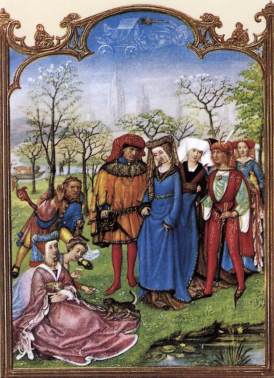
The illustration above is from the Grimani Breviary – another famous and well known religious manuscript that contains over 800 pages with 110 illustrations. It was printed in the late 1400’s. The illustration depicted is for the Month of April when the trees are beginning to get blossoms. The illustration shows nobles (probably Flemish) going on a pleasure excursion into the countryside. Notice the style of the ladies gowns. The lady sitting on the ground is wearing a high waisted gown with the dress falling in heavy folds to the ground. The neckline and cuffs are trimmed in fur. By this time, the belts are getting wider. The hats are elaborate headdresses made on wire trims with fabric ends hanging shoulder length. The men are wearing shorter cloaks that are fur trimmed. Underneath are high collars. All the men are wearing leggings. Notice that some of the men are wearing shoes with pointed toes. These shoe styles were adapted from Middle Eastern and Asian styles brought back by the Crusaders.
 The Victorian Shoppe