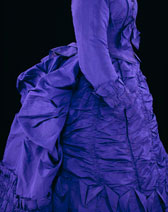
For much of history, the color of clothing was limited to plant-based and other natural dye colors. The first synthetic dye was accidentally discovered by an eighteen year old student attending the Royal College of Chemistry in London in 1856. Sir William Henry Perkin (1838-1907), was experimenting with a synthetic formula to replace the natural anti-malarial drug quinine. He produced a reddish powder instead of the colorless quinine. To better understand the reaction he tested the procedure using aniline and created a crude black product that when purified, dried and diluted with wine produced a mauve dye. Perkins filed a patent on this beautiful lustrous colored dye that became known as ‘aniline violet’ or ‘mauveine’.
Textile manufacturers embraced his aniline dye process and the resulting fabrics were characterized by an unprecedented brilliance and intensity that were a huge success with women consumers. Soon other synthetic dyes were being produced in vivid greens, blues, yellows and reds.
The featured dress from the Victoria and Albert Museum closely resembles the aniline violet and purple fabric samples dyed with Perkin and Sons aniline colors. The dress is made of silk and dates to the early 1870’s.
If you are planning to make or purchase a Victorian style gown for an upcoming event and the event period is circa 1860 or later, consider replicating the aniline dye colors. My personal favorites for ballgowns are silk or taffeta fabric in jewel tones – ruby, sapphire, emerald and copper. The gowns always look stunning.
(Source: Victoria and Albert Museum website http://www.vam.ac.uk)
 The Victorian Shoppe