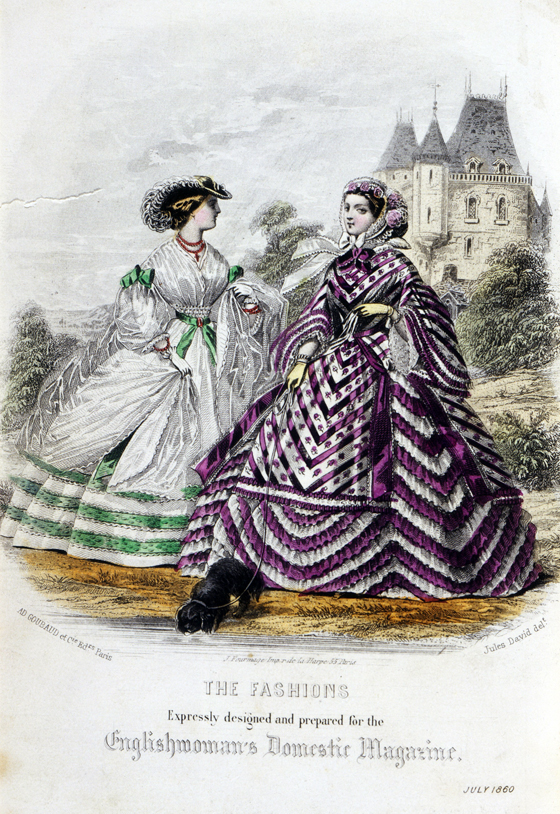
The clothing of the early 1860’s held an air of refinement and elegance. During the daytime ladies did not expose their arms or shoulders; necklines were very prim and proper. The classical silhouette was a snug bodice, full sleeves, and wide skirts which helped to emphasize a small waistline.
Outfits consisted of a very full skirt and a waist-length bodice that were made separately and then often sewn together to prevent gaps along the mid-section. The bodices fit snug; boning was used to give the bodice a smooth appearance and help maintain its shape. Sometimes the bodices had double points that extended in varying lengths down the front of the skirt. Blouses were a fashionable alternative to bodices. The popular “Garibaldi” blouse had distinctive narrow trim where it fastened down the front center and along the top of the shoulder, cuffs, and waistband. Ladies also wore a standard white “Spencer” or “waist”, which were plain white blouses under a shawl or open jacket. The “Zouave” jacket featured wide, full sleeves and fastened at the throat, then curved outward to expose the blouse underneath.
Skirts were known for their great volume. The hoopskirt was introduced in 1856 to support the very full skirts. Usually a ruffled petticoat was worn over the hoopskirt to hide the bones of the hoop and allow the overskirt to drape gracefully.
Undersleeves were often worn under the full, wide sleeves of the bodices and jackets to add a touch of elegance as they billowed softly from below while hiding the lady’s arm from view.
Necklines were usually rounded and came to the base of the neck. Often removable collars lay directly on top of the bodice.
Underneath the outfit ladies would wear a loose, low-necked chemise, a corset, and a corset cover (to soften the rigid lines of the corset).

