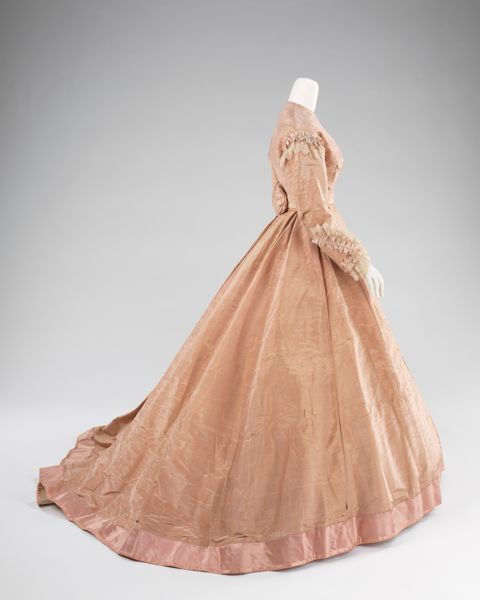
Ladies fashion during the American Civil War and the years leading up to it were known as the hoop-skirt era. The desired silhouette was focused on the hourglass figure. A corset was worn to pull in the waistline while the skirts were extremely full. Most of the skirts featured a hoop around the bottom to help create a fuller, more flared out appearance. The dresses themselves were frequently adorned with things like ribbon, lace, fringe, braids and flounces.
Petticoats were stiffened with horsehair to give fullness. There were reports of ladies wearing 6 or more petticoats under their ball gowns. As early as 1853 some dressmakers inserted whalebone hoops into the lining of skirts. In 1854 The Ladies Companion suggested putting pieces of straw underneath each flounce to stiffen it. One of the earliest patents by William Thomas and John Marsh in 1849 was for a structure composed of India rubber tubes threaded through hollow lengths of wood to create elastic and flexible hoops.
A British patent of May 1856 by J Gedge is described as a garment of airtight material (not specified) with a small nozzle for the insertion of a bellows for inflating it and a larger aperture for the escape of air when the wearer sits down. (Not sure that anyone ever tried this one!) A more practical patent by C Amet was filed in 1856 for a “crinoline made up of a number of covered steel springs … fastened to strong pieces of tape … so as to form a ‘skeleton petticoat’.” The steel springs made the garment lightweight, pliable, and relatively inexpensive. The largest crinoline manufacturer in London was Thomson, which produced over 4000 crinolines/day.
The type of crinoline patented by C. Amet enabled a lady to wear only one petticoat under the crinoline, plus a decorative petticoat over the crinoline to help conceal the ridges of the hoops within the crinoline.
There were some dangers associated with wearing the crinoline. Occasionally women would get their hoops tangled in carriage wheels. Most frequent and fatal accidents were caused by the highly flammable light fabrics getting too close to a fireplace or burning candle and catching fire. The worst disaster was on Dec 8, 1863 when 2000 women were killed in the Cathedral at Santiago, Chile. A fabric wall draping caught fire. The mostly women attendees panicked and tried to escape but the side doors had been closed in order to leave space to accommodate more people (they could be opened only inwards), leaving the main entrance as the only exit. The big hoop-skirts worn at the time made escape very difficult if not impossible, causing the people at the front to fall down and be trampled by the ones behind.
If you are creating a Civil War ball gown, you can usually buy the circular shaped crinolines at local bridal stores. Towards the end of the Civil War era and afterwards skirts were more elliptical in shape. To get the correct silhouette you will probably have to make your own. Truly Victorian has a pattern for an elliptical crinoline (circa 1863-1869).

 The Victorian Shoppe